Construction sites need reliable power every day. From electric tools and temporary lighting to mobile offices, communications equipment, security systems, and charging stations, electricity plays an essential role in keeping projects moving.
For decades, diesel generators have been one of the most common solutions for temporary construction power. However, contractors and project managers are increasingly exploring a different approach: mobile battery power for construction sites.
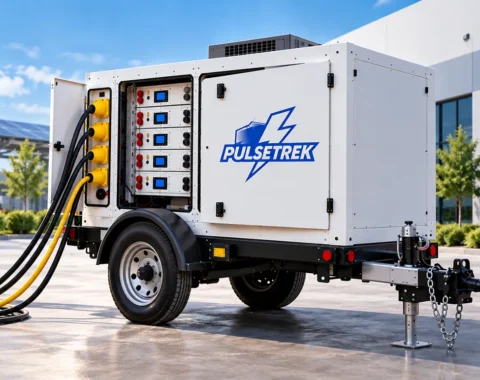
Modern Mobile Battery Energy Storage Systems (BESS) can provide transportable, quiet, and flexible electrical power without requiring continuous engine operation.
For construction companies looking to modernize temporary power infrastructure, mobile battery storage offers an increasingly practical solution.
What Is a Mobile Battery Energy Storage System?
A Mobile Battery Energy Storage System is a transportable power solution that stores electrical energy in rechargeable batteries.
Unlike a diesel generator, which must burn fuel to continuously generate electricity, a battery system stores electricity and delivers it when equipment requires power.
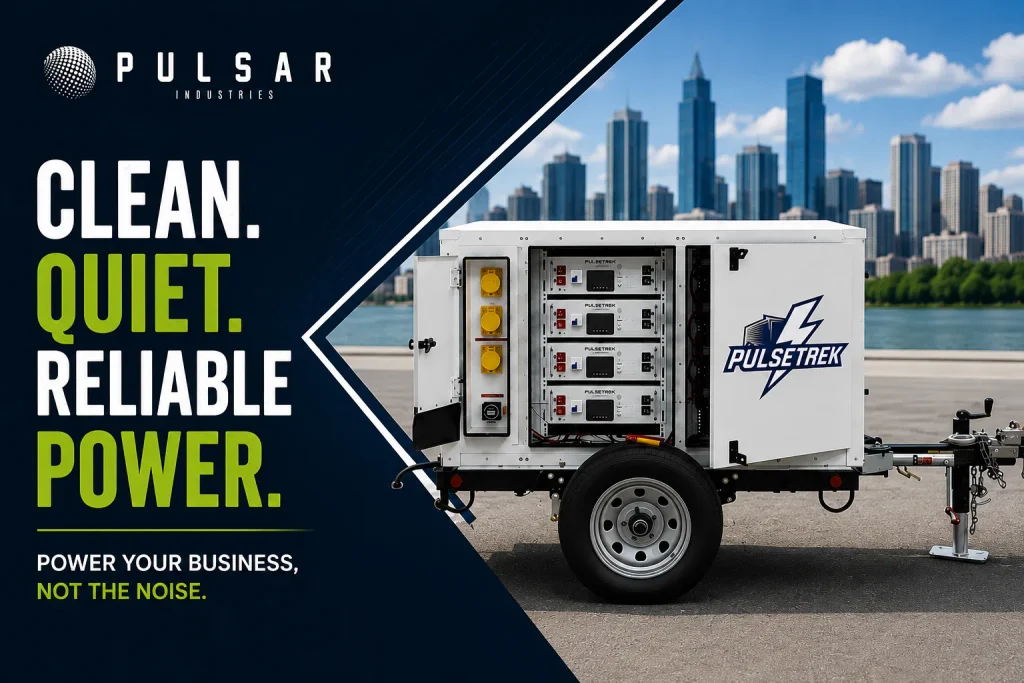
A mobile BESS may include:
- Lithium battery modules
- Battery Management System (BMS)
- Inverter and power electronics
- Charging equipment
- Electrical protection systems
- Monitoring and control technology
- Weather-resistant enclosure
- Trailer or mobile platform
The entire system can be transported to locations where temporary electricity is required.
This makes mobile battery storage particularly useful for construction companies working across multiple job sites.
Why Construction Sites Need Better Temporary Power
Construction power requirements can change significantly throughout a project.
During early development, permanent electrical infrastructure may not even be available.
Contractors may need temporary power for:
- Electric power tools
- Job site lighting
- Security equipment
- Cameras and monitoring systems
- Communications equipment
- Mobile offices
- Computers and electronics
- Battery chargers
- Pumps
- Small machinery
- Temporary facilities
Traditional generators can handle many of these requirements, but they also introduce fuel, noise, maintenance, and logistics considerations.
A construction site battery power system provides another way to supply electricity.
1. Reduce Noise on Construction Sites
Noise is a significant consideration on many construction projects.
Diesel generators create continuous engine noise whenever they operate.
This can become particularly challenging on projects located near:
- Residential neighborhoods
- Hospitals
- Schools
- Hotels
- Commercial offices
- Entertainment venues
- Urban developments
Battery systems operate without a combustion engine running continuously.
As a result, mobile battery storage can provide extremely quiet power at the point of use.
This can be especially useful for nighttime construction, indoor-adjacent projects, and noise-sensitive environments.
2. Reduce Dependence on Generator Fuel
Running a conventional generator requires fuel.
That means contractors must consider:
- Fuel purchasing
- Fuel transportation
- On-site fuel storage
- Refueling schedules
- Fuel price fluctuations
- Fuel handling requirements
Battery storage changes this operating model.
A mobile battery system can be charged from compatible electrical sources and then transported or deployed where electricity is required.
Depending on system configuration, battery storage can also be integrated with renewable energy sources such as solar.
Reducing dependence on continuous fuel consumption can simplify temporary power logistics for certain construction applications.
3. Lower Routine Engine Maintenance
Diesel generators contain combustion engines and mechanical components that require regular maintenance.
Typical generator maintenance can include:
- Oil changes
- Filter replacements
- Engine inspections
- Fuel system maintenance
- Coolant checks
- Mechanical servicing
Battery energy storage systems do not contain the same type of continuously operating combustion engine.
This can reduce many routine engine-related maintenance requirements.
For companies managing equipment across multiple construction projects, fewer mechanical maintenance requirements can simplify fleet operations.
4. Mobile Power That Moves Between Projects
Construction companies rarely operate from only one location.
Equipment frequently moves from one project to another.
This makes mobility extremely valuable.
A battery power trailer for construction sites can be transported to the project, positioned where electricity is required, and moved again when requirements change.
Instead of installing permanent infrastructure for temporary needs, contractors can deploy mobile energy storage where power is required.
Applications may include:
Site A: Temporary lighting and tools
Site B: Mobile office and communications
Site C: Equipment charging
Site D: Emergency backup power
One mobile power asset can therefore support different requirements across multiple projects.
5. Battery Power for Electric Construction Equipment
Construction equipment is gradually becoming more electrified.
Electric tools, battery-powered equipment, electric vehicles, and other electrically powered machinery are becoming more common on modern job sites.
But electrification creates a new challenge:
Where does the charging power come from when permanent electrical infrastructure is unavailable?
Mobile battery energy storage can help bridge this infrastructure gap.
A sufficiently engineered system can provide electricity for charging compatible equipment without requiring permanent charging infrastructure at every location.
This makes mobile BESS technology increasingly relevant as the construction industry adopts more electric equipment.
6. Cleaner Power at the Point of Use
Diesel generators create exhaust emissions while operating.
Battery systems do not burn fuel while discharging stored electricity.
Therefore, there are no combustion exhaust emissions at the point where battery power is being used.
This can be useful in projects where equipment operates:
- Near occupied buildings
- In dense urban environments
- Near indoor work areas
- Around temporary offices
- In environmentally sensitive locations
The overall environmental impact of any energy system depends on how electricity is generated and how the batteries are manufactured and charged.
However, eliminating on-site combustion can still provide meaningful operational advantages.
Mobile Battery Storage vs. Diesel Generator
Choosing between a battery storage system and a conventional generator depends on the specific application.
Diesel Generator
Traditional generators can provide long-duration power as long as fuel remains available.
However, they generally involve:
- Engine noise
- Fuel consumption
- Exhaust emissions
- Regular engine maintenance
- Fuel transportation and storage
Mobile Battery Energy Storage
Battery storage provides electricity from stored energy.
Potential advantages include:
- Quiet operation
- No on-site fuel combustion while discharging
- Reduced engine-related maintenance
- Mobile deployment
- Renewable energy compatibility
- Flexible charging options
- Support for electric equipment
For some projects, batteries and generators may also be combined into hybrid systems.
The best solution depends on power requirements, runtime, charging availability, project duration, and operating conditions.
PulseTrek: Mobile Battery Power from Pulsar Industries
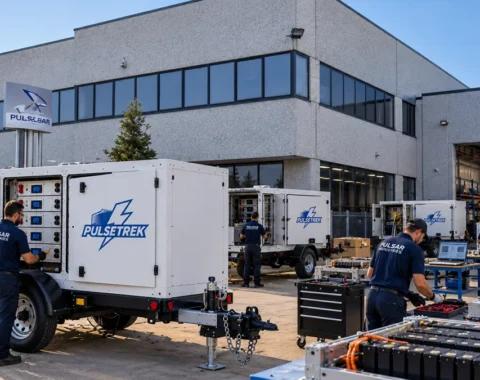
Pulsar Industries developed PulseTrek to provide transportable battery power for demanding commercial and professional applications.
PulseTrek combines lithium battery technology, power electronics, controls, and a mobile trailer platform to bring stored electrical energy directly to the location where it is needed.
The platform is particularly suited for applications such as:
- Construction
- Temporary power
- Mobile operations
- Emergency response
- EV charging
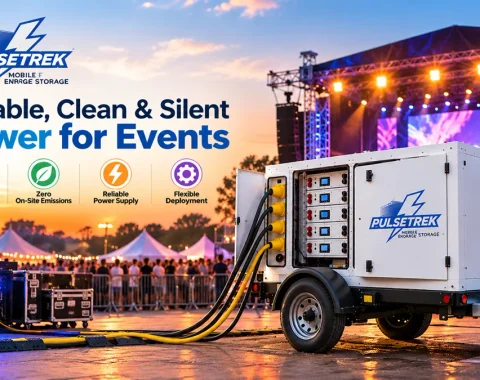
- Events
- Film and television production
- Telecom and utility work
- Remote operations
Rather than moving fuel to a generator, organizations can move stored electrical energy to the point where power is required.
LiFePO4 Battery Technology for Construction Power
Mobile battery systems require battery chemistry capable of handling repeated charging and discharging.
Lithium Iron Phosphate, commonly known as LiFePO4 or LFP, has become an important battery chemistry for energy storage applications.
LFP technology offers characteristics that make it attractive for commercial battery systems, including:
- Long cycle life
- Thermal stability
- Reliable performance
- High efficiency
- Suitability for repeated cycling
For construction companies, battery cycle life is particularly important because mobile power equipment may be used repeatedly across many projects.