Choosing a battery energy storage system is not simply about selecting how many kilowatt-hours of storage a facility needs.
One of the most important decisions happens much earlier:
Which battery chemistry should the system use?
Lithium Iron Phosphate (LFP or LiFePO4) and Nickel Manganese Cobalt (NMC) are two important lithium-ion chemistries used across modern battery applications. Both can deliver excellent performance, but they have different characteristics.
The right choice depends on the application’s required cycle life, available space, weight limitations, operating environment, thermal management requirements and overall system design.
At Pulsar Industries, battery systems are engineered around the actual application rather than forcing every project into a standard battery configuration.
What Is an LFP Battery?
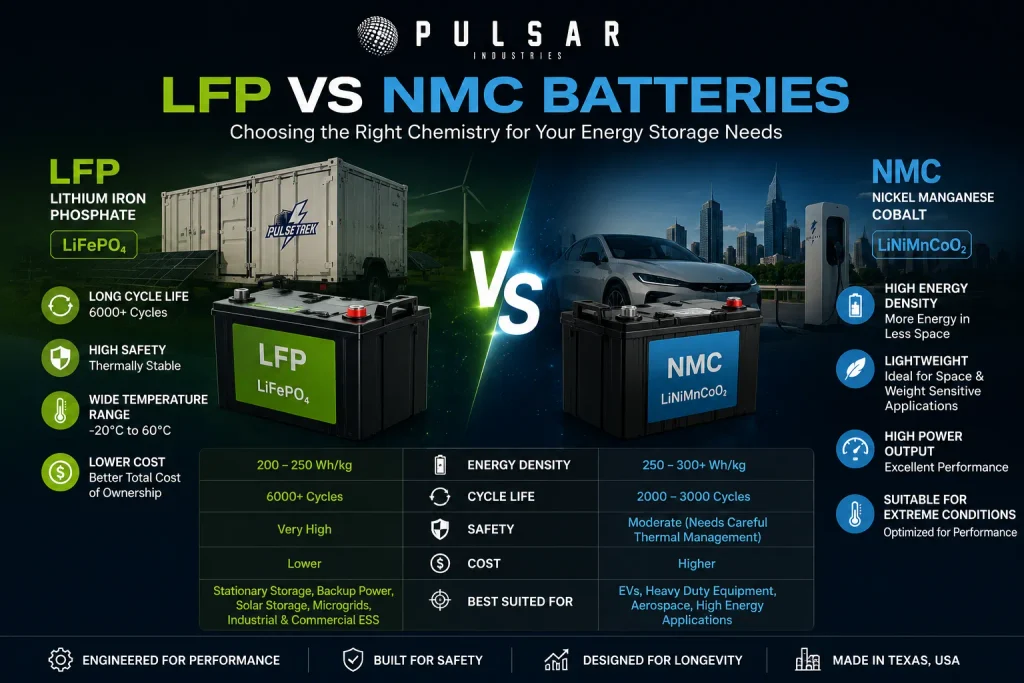
Lithium Iron Phosphate, commonly called LFP or LiFePO4, is a lithium-ion battery chemistry widely used in stationary and commercial energy storage.
LFP has become particularly attractive for applications where batteries are expected to charge and discharge repeatedly over many years.
Pulsar Industries identifies LFP as its primary chemistry for many stationary and semi-mobile energy storage applications.
Common applications include:
- Commercial battery storage
- Industrial energy storage
- Solar energy storage
- Telecom backup
- Data center backup
- Construction power
- Mobile energy storage
- Off-grid systems
- Renewable energy projects
For these applications, longevity and dependable cycling can be more important than minimizing the physical size of the battery.
What Is an NMC Battery?
NMC stands for Nickel Manganese Cobalt.
Like LFP, NMC is part of the lithium-ion battery family. However, its characteristics make it attractive for different applications.
One of NMC’s major advantages is energy density.
Higher energy density means more energy can be stored within a smaller and lighter battery pack.
According to Pulsar Industries’ battery technology guidance, NMC/NCA can provide substantially greater energy density than LFP, making these chemistries useful when weight and physical dimensions are critical design constraints.
Examples can include electric vehicles, mobile industrial equipment and other applications where space and weight matter.
LFP vs NMC: The Major Differences
There isn’t one battery chemistry that is automatically best for every application.
Understanding the differences helps businesses make a better engineering decision.
1. Cycle Life
Cycle life describes how many charge-and-discharge cycles a battery can complete before its usable capacity significantly decreases.
This is especially important in commercial energy storage because a battery may cycle every day.
Pulsar states that its LFP approach can deliver 6,000 or more full charge-discharge cycles before reaching 80% of original capacity, compared with approximately 2,000–3,000 cycles cited for NMC in its energy-storage guidance.
For a stationary system expected to operate for many years, this difference can significantly influence battery selection.
2. Energy Density
NMC has an advantage when energy density is the priority.
A higher-energy-density battery can store more energy within a limited amount of space and weight.
This is extremely important in applications such as:
Electric vehicles: additional battery weight directly affects vehicle efficiency.
Mobile equipment: physical space for batteries may be limited.
Specialized industrial machinery: the battery may need to fit into an existing enclosure.
Stationary commercial energy storage usually has more flexibility regarding physical footprint, making LFP’s other characteristics particularly attractive.
3. Thermal Management
Battery temperature directly affects performance, safety and longevity.
Every commercial lithium battery system requires appropriate thermal management, monitoring and electrical protection.
However, different chemistries can require different engineering approaches.
Pulsar notes that NMC applications generally require more complex thermal management than LFP applications.
This is why battery chemistry cannot be selected independently from the complete system architecture.
Why LFP Is Popular for Commercial Battery Energy Storage
Commercial battery systems have different priorities from smartphones or electric cars.
A commercial BESS may remain installed at the same facility for many years.
In this environment, priorities typically include:
- Long operational life
- Frequent cycling
- Reliable performance
- Manageable thermal behavior
- Low maintenance
- Predictable degradation
- Scalable capacity
- Competitive total cost of ownership
These requirements align well with LFP technology.
That’s why LFP is increasingly used for commercial buildings, industrial facilities, renewable energy projects and stationary backup systems.
Pulsar Industries uses LFP across many of its energy-storage applications and describes it as the chemistry it recommends in the large majority of stationary and semi-mobile projects.
Battery Chemistry Is Only Part of a BESS
A common mistake is evaluating a battery energy storage system based only on the cells.
The cells are important, but they are only one component.
A properly engineered BESS may include:
Battery Cells → Modules → BMS → Thermal Management → Inverter → EMS → Electrical Protection → Enclosure
All of these components need to work together.
Pulsar Industries specifically describes energy storage as an engineered system rather than a commodity product, emphasizing cell arrangement, thermal management, BMS controls, enclosure design and electrical integration.
That distinction matters.
Two systems using similar battery cells can perform very differently depending on how the complete system has been engineered.
The Role of the Battery Management System
The Battery Management System (BMS) is one of the most important components in a lithium battery system.
It helps monitor and manage parameters such as:
- Cell voltage
- Battery current
- Temperature
- Charging
- Discharging
- Protection thresholds
- Battery state
For commercial applications, proper BMS engineering helps ensure that the battery operates within its intended limits.
Pulsar’s engineering capabilities include custom BMS development and system-level battery engineering.
LFP for Solar Energy Storage
Solar power generation changes throughout the day.
Battery storage allows excess solar electricity to be stored and used later.
The basic architecture is:
Solar Generation → Battery Storage → Energy Management → Facility Load
Because solar batteries may experience frequent partial and full cycling, cycle life becomes particularly important.
Pulsar notes that LFP handles partial states of charge well, making it suitable for applications such as solar storage where batteries aren’t necessarily fully cycled every time.
LFP for Commercial and Industrial Backup Power
Power interruptions can create significant problems for commercial and industrial facilities.
Battery storage can support critical loads during grid disruptions and can also participate in normal energy management when the grid is operating.
Potential applications include:
- Manufacturing facilities
- Warehouses
- Data centers
- Telecom facilities
- Commercial buildings
- Cold storage
- Industrial automation
- Critical infrastructure
Pulsar’s industrial battery storage solutions are designed around backup power, peak shaving and renewable integration for demanding commercial and industrial environments.
What About Mobile Battery Systems?
Mobile systems introduce another engineering consideration: weight.
A stationary BESS may tolerate a larger physical footprint, while a mobile battery system must account for transportation limits, enclosure dimensions and total system weight.
This means LFP isn’t automatically the answer for every mobile application.
Pulsar takes a technology-agnostic approach, evaluating LFP, NMC and other chemistries according to actual project requirements.
That’s an important principle:
Choose the chemistry for the application — don’t redesign the application around the battery chemistry.
How to Select the Right Battery Chemistry
Before selecting LFP, NMC or another battery technology, businesses should answer several questions:
How much energy is required?
Determine the required kWh capacity.
What is the maximum power demand?
Determine both continuous and peak kW requirements.
How frequently will the battery cycle?
Daily cycling makes long-term cycle performance particularly important.
How much physical space is available?
Limited space may make energy density more important.
Does system weight matter?
Weight becomes especially important for vehicles and mobile equipment.
What temperatures will the battery experience?
The operating environment affects thermal-management requirements.
How long should the system operate before replacement?
Expected service life should be considered alongside upfront cost.
Will capacity need to expand later?
Commercial facilities with growing energy requirements may benefit from modular system architecture.
Total Cost Matters More Than Battery Purchase Price
The lowest-cost battery isn’t necessarily the lowest-cost energy storage solution.
Businesses should evaluate total cost of ownership.
That includes:
- Initial system cost
- Engineering
- Installation
- Cycle life
- Energy efficiency
- Maintenance
- Thermal management
- Monitoring
- Expected replacement schedule
- System downtime
- Expansion requirements
A battery with a higher upfront price but longer usable life may ultimately provide better economics.
This is particularly relevant for systems that cycle frequently.
Why Custom Battery Engineering Matters
Commercial energy storage requirements vary dramatically.
A telecom tower does not have the same requirements as a manufacturing facility.
A data center does not have the same requirements as mining equipment.
And a mobile power trailer does not have the same design constraints as a containerized BESS.
That’s why battery selection should begin with the application.
Pulsar Industries provides battery consulting, engineering, prototyping, manufacturing and energy-storage capabilities under one organization, allowing projects to move from initial requirements through production.
LFP or NMC: Which Should You Choose?
For many stationary commercial and industrial energy storage applications, LFP can be a strong choice when cycle life, long-term operation and thermal characteristics are priorities.
NMC can become attractive when energy density, physical size and weight are critical.
But the final answer depends on the application.
Instead of asking:
“Which battery chemistry is best?”
A better question is:
“Which battery chemistry is best for this specific application?”
That’s the question battery engineering should answer.
Build the Right Battery System with Pulsar Industries
Battery cells are only the starting point.
A successful energy storage system requires the right chemistry, BMS, electrical architecture, thermal management, enclosure, controls and manufacturing process working together.
Pulsar Industries designs and manufactures custom lithium battery systems in Texas and supports projects from initial concept through engineering, prototyping and production.
Whether the application involves commercial energy storage, industrial equipment, renewable energy, mobile power or critical infrastructure, selecting the right battery chemistry is one of the first steps toward building a system designed for long-term performance.
FAQs
Is LFP better than NMC for energy storage?
For many stationary energy-storage applications, LFP is attractive because of its cycle-life and thermal characteristics. NMC can be advantageous when higher energy density and lower weight are more important.
What does LiFePO4 mean?
LiFePO4 stands for lithium iron phosphate. It is commonly abbreviated as LFP and is a type of lithium-ion battery chemistry.
How many cycles can an LFP battery last?
Cycle life varies according to cell design, operating conditions, depth of discharge and system management. Pulsar cites 6,000+ full charge-discharge cycles before reaching 80% original capacity for the LFP technology described in its energy-storage guidance.
Is LFP suitable for solar battery storage?
Yes. LFP is commonly suited to solar and stationary storage applications, particularly where repeated cycling and partial states of charge are expected.
Does Pulsar Industries manufacture custom battery systems?
Yes. Pulsar Industries describes its capabilities as covering battery consulting, engineering, prototyping and in-house manufacturing in Texas.
Recommended internal links: link the phrases Energy Storage, Battery Energy Storage Systems, Industrial Battery Storage Solutions, Engineering, and Manufacturing to their corresponding Pulsar Industries pages. This will connect the informational blog with the site’s commercial/service pages.