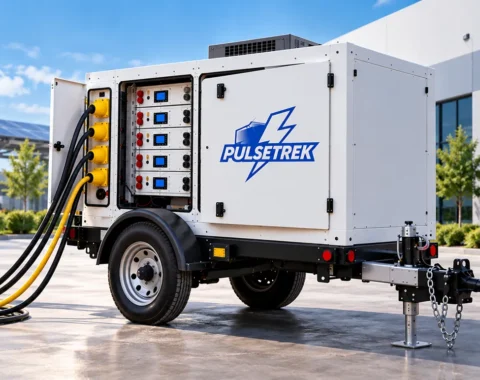
Modern businesses need reliable energy solutions that match their unique operational requirements. However, standard off-the-shelf batteries may not always provide the right voltage, capacity, dimensions, performance, safety, or communication features.
This is where custom battery system development becomes valuable.
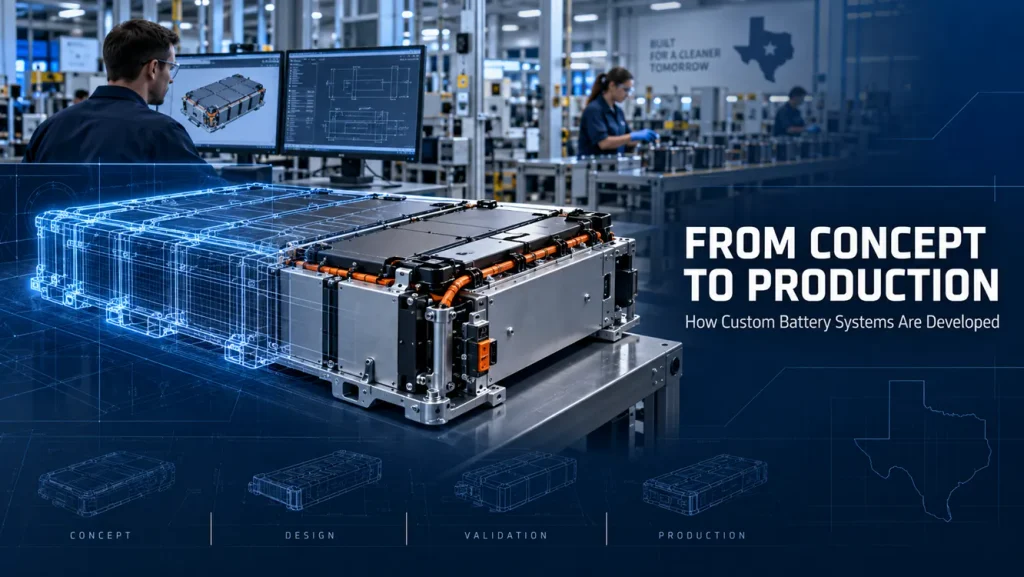
A custom battery system is designed around the exact needs of an application. From determining power requirements to manufacturing and quality testing, every stage helps create a safe, efficient, and dependable energy solution.
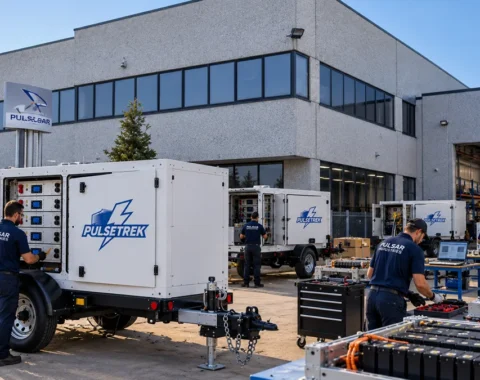
At Pulsar Industries, we support battery projects from initial concept and engineering to system integration and production.
What Is a Custom Battery System?
A custom battery system is an energy storage solution developed for a particular product, machine, vehicle, facility, or commercial application.
Unlike a standard battery, a custom system can be configured according to:
- Required voltage and energy capacity
- Continuous and peak power demand
- Available installation space
- Weight limitations
- Charging requirements
- Operating temperature
- Communication protocols
- Safety and compliance requirements
- Expected cycle life
- Environmental conditions
The objective is to develop a battery that works efficiently within the complete electrical and mechanical system—not simply to assemble a group of battery cells.
Step 1: Understanding the Application
Every successful battery project begins with a detailed assessment of the application.
Battery engineers need to understand how the system will be used, where it will operate, and how much energy it must deliver. Important considerations include:
- What equipment will the battery power?
- How much continuous power is required?
- Are there high startup or peak loads?
- How long should the system operate between charges?
- Will the battery be used indoors or outdoors?
- What temperature and weather conditions will it encounter?
- How much physical space is available?
- How frequently will the battery be charged and discharged?
Clearly defining these requirements helps prevent oversizing, insufficient capacity, thermal issues and unnecessary development costs.
Step 2: Selecting the Right Battery Chemistry
Battery chemistry has a major effect on performance, safety, weight, lifespan and cost.
Lithium-ion chemistries are widely used because of their high energy density, charging efficiency and long service life. Lithium iron phosphate, commonly known as LFP or LiFePO₄, is frequently selected for commercial and industrial applications because of its thermal stability and cycle-life potential.
The appropriate chemistry depends on the application. Engineers evaluate factors such as:
- Energy density
- Power output
- Thermal stability
- Charging speed
- Expected cycle life
- Operating temperature
- Weight
- Cost
- Maintenance requirements
The best battery chemistry is not necessarily the one with the highest capacity. It is the chemistry that delivers the right balance of performance, safety and long-term value.
Step 3: Electrical and Mechanical Engineering
Once the technical requirements and chemistry have been established, the electrical and mechanical design process begins.
Electrical Design
The electrical design determines how battery cells and modules will be connected to achieve the required voltage, capacity and power output.
Engineers may design:
- Cell and module configurations
- High-current connections
- Wiring and busbars
- Fuses and circuit protection
- Charging interfaces
- Power input and output connections
- Communication and monitoring systems
Mechanical Design
The enclosure must protect the battery while fitting correctly within the intended equipment or installation area.
Mechanical engineering considers:
- Enclosure dimensions
- Structural strength
- Cooling and ventilation
- Water and dust resistance
- Vibration and impact protection
- Service access
- Mounting requirements
- Cable and connector placement
Electrical and mechanical components must work together as one integrated system.
Step 4: Battery Management System Integration
The Battery Management System, or BMS, acts as the control and protection center of a lithium battery system.
It continuously monitors important operating conditions, including:
- Individual cell voltage
- Total pack voltage
- Charging and discharging current
- Battery temperature
- State of charge
- System faults
- Cell balancing
A properly configured BMS can help protect the system from overcharging, excessive discharge, overcurrent, short circuits and unsafe temperatures.
For advanced applications, the BMS may also communicate with chargers, inverters, controllers or monitoring platforms through protocols such as CAN bus or RS-485.
Step 5: Prototype Development
Before entering full production, a prototype is developed to confirm that the design performs as intended.
Prototype development allows engineers to evaluate:
- Physical fit
- Electrical performance
- Power delivery
- Charging behaviour
- Thermal performance
- BMS communication
- Connector placement
- Installation requirements
- Ease of maintenance
If an issue is discovered during testing, the design can be updated before manufacturing larger quantities. This reduces production risk and helps avoid expensive modifications later.
Step 6: Testing and Validation
Testing is one of the most important stages in custom battery system development. The exact validation process depends on the application, operating environment and relevant regulatory requirements.
Testing may include:
- Capacity testing
- Charge and discharge cycle testing
- Peak-load testing
- Temperature monitoring
- Thermal performance testing
- Vibration testing
- Impact resistance testing
- Water and dust protection testing
- Short-circuit protection testing
- BMS fault testing
- Communication testing
Testing confirms whether the battery can deliver the required performance while operating safely under expected conditions.
Step 7: Certification and Compliance Planning
Battery products may need to meet specific transportation, safety or industry standards before they can be shipped or deployed.
Certification requirements depend on the battery chemistry, system size, application and target market. Considering compliance early in the development process is essential because certification requirements can affect cell selection, enclosure design, wiring, protection systems and product documentation.
Early planning can reduce redesigns and make the transition from prototype to commercial production more efficient.
Step 8: Production and Quality Control
After the prototype is validated and the design is finalized, the system can move into production.
A controlled manufacturing process may include:
- Incoming component inspection
- Cell testing and matching
- Module assembly
- Electrical connection and wiring
- BMS installation and programming
- Enclosure integration
- Functional testing
- Final quality inspection
- Labelling and documentation
- Packaging and shipment
Consistent documentation and quality-control procedures help ensure that every manufactured battery meets the approved design and performance requirements.
Why Work With a Full-Service Battery Partner?
Managing engineering, sourcing, prototyping, testing and manufacturing through multiple suppliers can create communication gaps, delays and compatibility problems.
Working with one experienced battery partner provides several benefits:
- A coordinated development process
- Better integration of electrical and mechanical components
- Faster identification of technical issues
- Improved component compatibility
- Consistent quality control
- Easier transition from prototype to production
- Long-term technical support
Pulsar Industries provides engineering, battery system development, in-house manufacturing, strategy consulting and technology insights—giving businesses one partner throughout the battery project lifecycle.
Applications for Custom Battery Systems
Custom battery solutions can support a wide range of industries and applications, including:
- Commercial energy storage
- Mobile power systems
- Backup power solutions
- Industrial machinery
- Recreational vehicles
- Golf carts and utility vehicles
- Off-grid equipment
- Construction equipment
- Renewable energy systems
- Specialized electric vehicles
- Portable and temporary power systems
Each application presents different challenges, which is why careful system-level engineering is essential.
Build Your Battery System With Pulsar Industries
Developing a custom battery system requires more than selecting cells and placing them inside an enclosure. It demands careful planning, electrical and mechanical engineering, BMS integration, prototype development, testing and controlled manufacturing.
Pulsar Industries North America Inc. helps businesses move their battery projects from initial concept to production. Our Texas-based team develops battery solutions around specific performance, integration and operational requirements.
Whether you are developing a new product, improving an existing battery system or preparing for larger-scale production, our team can help you determine the right development approach.
Contact Pulsar Industries today to discuss your custom battery system requirements.
Frequently Asked Questions
How long does it take to develop a custom battery system?
The development timeline depends on system complexity, component availability, prototype revisions, testing and certification requirements. A detailed technical assessment is required before establishing an accurate schedule.
Can an existing battery system be redesigned?
Yes. An existing system can be evaluated for improvements in capacity, power delivery, charging, BMS functionality, enclosure design, weight or service life.
What information is required to start a battery project?
Useful starting information includes the required voltage, capacity, continuous and peak power, available dimensions, operating temperature, charging method and intended application.
Does every custom battery require certification?
Certification requirements depend on the battery’s chemistry, capacity, application, transportation method and target market. These requirements should be evaluated early in the project.
Can Pulsar Industries support both prototypes and production?
Yes. Pulsar Industries supports multiple stages of battery development, including engineering, prototyping, integration and manufacturing.