Modern businesses depend on reliable electricity more than ever. Manufacturing equipment, HVAC systems, data infrastructure, lighting, EV chargers, refrigeration, automation, and other critical operations all require a stable supply of power.
At the same time, businesses are dealing with rising electricity costs, peak demand charges, grid instability, and growing pressure to integrate renewable energy.
This is why Commercial Battery Energy Storage Systems (BESS) are becoming an important part of modern energy infrastructure.
A commercial battery energy storage system allows a business to store electricity and use that energy when it provides the greatest operational or financial benefit.
What Is a Commercial Battery Energy Storage System?
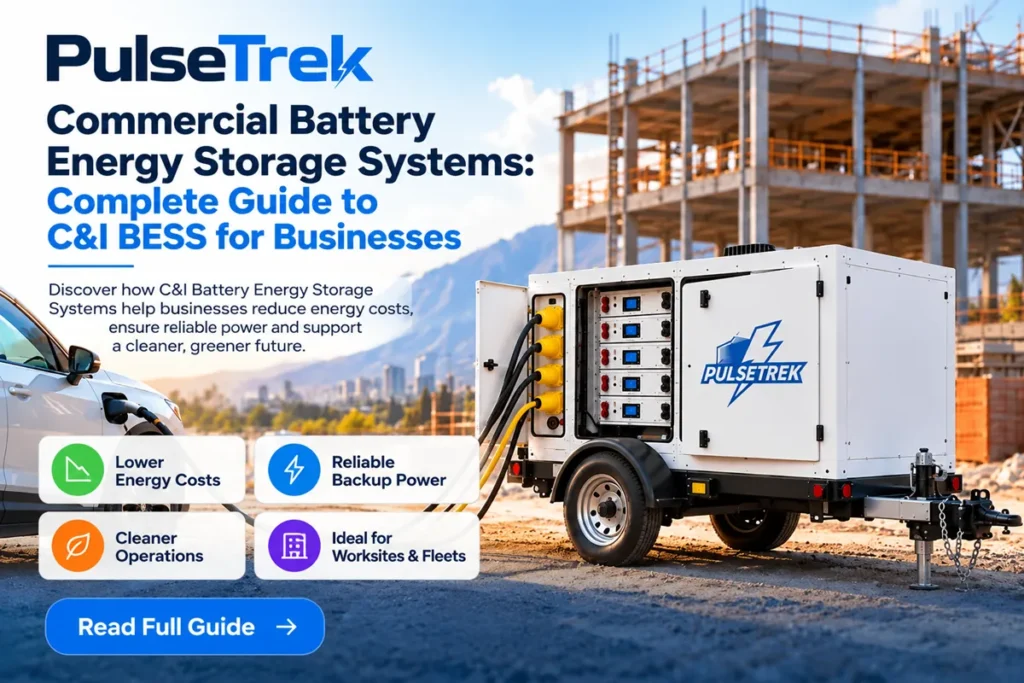
A Commercial Battery Energy Storage System, often called C&I BESS, is an energy storage solution designed for commercial and industrial facilities.
Unlike small residential batteries, commercial energy storage systems are engineered to support larger electrical loads and more demanding operating environments.
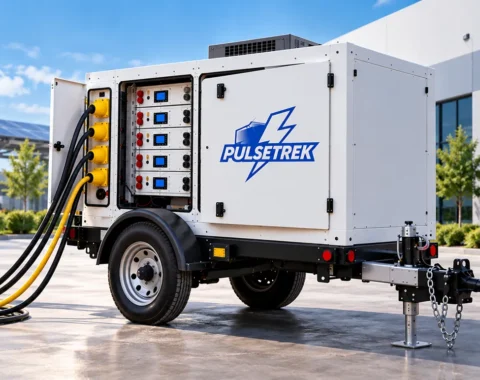
A typical C&I battery storage system includes:
- Battery modules
- Battery Management System (BMS)
- Power Conversion System (PCS)
- Inverter technology
- Energy Management System (EMS)
- Electrical protection equipment
- Monitoring and control systems
- Thermal management
- Industrial enclosure
Together, these components allow electricity to be stored, monitored, controlled, and delivered according to the facility’s requirements.
How Does a Commercial Battery Storage System Work?
The basic principle is straightforward.
The battery charges when electricity is available from the grid, solar panels, or another compatible energy source.
Stored electricity can then be discharged when the facility requires additional power.
For example:
Grid or Solar → Battery Storage → Commercial Facility
The real advantage comes from deciding when to charge and when to discharge.
A properly engineered energy management system can help coordinate battery operation around facility demand, available solar generation, backup requirements, and electricity pricing.
Why Are Businesses Investing in C&I BESS?
Businesses have different reasons for installing commercial battery storage.
For some companies, reducing electricity costs is the priority.
For others, maintaining power during outages is more important.
Industrial facilities may need better management of large electrical loads, while companies with solar installations may want to store excess renewable electricity.
Commercial battery storage can support several of these requirements within one energy infrastructure strategy.
1. Peak Shaving and Demand Management
One of the major applications of commercial battery energy storage systems is peak shaving.
Commercial and industrial facilities can experience short periods of very high electricity demand.
For example, a manufacturing facility might operate production equipment, compressors, pumps, HVAC systems, and other high-power machinery simultaneously.
These peaks can contribute significantly to electricity costs where demand-based utility pricing applies.
A BESS can discharge during periods of high facility demand, reducing the amount of electricity being drawn from the grid.
This strategy is commonly known as peak shaving.
Instead of allowing grid demand to rise sharply:
Normal Load + Battery Power = Lower Grid Peak
For suitable facilities and tariff structures, this can become an important part of electricity cost management.
2. Backup Power for Commercial Facilities
Power interruptions can be expensive.
Manufacturing facilities may experience production delays. Warehouses can lose critical systems. Offices can lose network connectivity, while commercial properties may experience interruptions to lighting, security, access control, and communications.
A commercial battery backup system can provide stored electricity to selected critical loads when grid power is interrupted.
Potential backup applications include:
- Manufacturing equipment
- Servers and IT infrastructure
- Telecommunications
- Security systems
- Emergency lighting
- Refrigeration
- Critical pumps
- Building controls
- Communication systems
The required battery capacity depends on the amount of equipment being supported and the desired backup duration.
3. Solar Plus Battery Storage
Commercial solar installations often generate electricity at times when the facility cannot immediately use all available production.
Instead of exporting or wasting the potential value of excess solar generation, businesses can store electricity in batteries.
The energy can then be used later.
A typical configuration may look like:
Solar Panels → Commercial Battery Storage → Facility Loads
This approach can increase the flexibility of a commercial solar installation.
Stored solar energy may be used during evening operations, high-demand periods, or other times when solar generation is unavailable.
4. Time-of-Use Energy Management
Electricity prices can vary depending on the time of day and the utility tariff.
Where time-of-use pricing applies, businesses may be able to charge batteries during lower-cost periods and use stored electricity when grid electricity becomes more expensive.
This strategy is often referred to as energy arbitrage or load shifting.
The effectiveness of the strategy depends on factors including:
- Utility tariff
- Battery efficiency
- Facility load profile
- Battery capacity
- Charging availability
- Peak and off-peak price differences
An intelligently controlled C&I BESS can automatically manage these operating schedules.
5. EV Charging Infrastructure Support
Electric vehicle adoption is creating new electrical demands for commercial properties.
Fleet depots, workplaces, warehouses, logistics centers, retail facilities, and industrial sites may install multiple EV chargers.
When several vehicles charge simultaneously, the resulting electrical load can be significant.
Commercial battery storage can help support EV charging infrastructure by storing electricity and supplying additional power during charging periods.
This can be particularly valuable for businesses expanding their EV charging capabilities while managing existing electrical infrastructure.
Commercial Battery Storage for Manufacturing
Manufacturing facilities are particularly suitable candidates for energy storage because they often have large and variable electrical loads.
Equipment such as:
- CNC machines
- Compressors
- Pumps
- Motors
- HVAC systems
- Conveyors
- Robotics
- Process equipment
can create significant changes in facility demand.
An industrial battery energy storage system can help manage these fluctuations while providing additional resilience for selected operations.
For manufacturers, BESS should be engineered around actual load data rather than selected solely according to battery capacity.
Commercial Battery Storage for Warehouses
Warehouses and distribution centers are also becoming increasingly electrified.
Modern facilities may use electricity for lighting, climate control, automation, material-handling equipment, IT infrastructure, refrigeration, and EV fleet charging.
Solar installations are also common on large warehouse rooftops.
Combining commercial solar and battery storage can allow warehouse operators to manage renewable energy more strategically while improving energy resilience.
Understanding kW vs. kWh in Commercial BESS
Two specifications are particularly important when selecting a battery energy storage system: kW and kWh.
kW — Power
Kilowatts indicate how much power the system can deliver at a particular moment.
A higher kW rating allows the battery system to support larger simultaneous electrical loads.
kWh — Energy
Kilowatt-hours indicate how much energy the battery can store.
A larger kWh capacity generally allows equipment to operate for a longer period, depending on the connected load.
Businesses therefore need to consider both specifications.
Selecting a large battery capacity without sufficient power output may not support the required equipment.
Likewise, high power output with insufficient energy capacity may provide only a short operating duration.
How to Size a Commercial Battery Energy Storage System
There is no universal BESS size that works for every business.
Proper sizing starts with understanding the facility.
Important factors include:
- Maximum facility demand
- Average electricity consumption
- Critical backup loads
- Required backup duration
- Existing solar generation
- Utility tariff structure
- Peak demand patterns
- Available electrical infrastructure
- Future EV charging requirements
- Expected business expansion
Historical electricity data and facility load profiles can provide valuable information during system design.
Why Battery Chemistry Matters
Battery chemistry can significantly affect system performance, cycle life, thermal characteristics, and overall system design.
Lithium Iron Phosphate, commonly known as LFP or LiFePO4, has become widely used for stationary commercial energy storage.
LFP batteries offer characteristics suitable for repeated cycling and long-term energy-storage applications.
However, battery chemistry should always be selected according to the requirements of the specific project rather than treating every energy-storage application as identical.
BMS and EMS: The Intelligence Behind Commercial Battery Storage
A commercial battery system is more than a collection of battery cells.
Two important technologies help control the system.
Battery Management System (BMS)
The BMS monitors battery conditions such as voltage, current, temperature, and state of charge.
Its role includes keeping the battery within appropriate operating limits.
Energy Management System (EMS)
The EMS operates at a broader facility level.
It can determine when the battery should charge or discharge based on factors such as:
- Building demand
- Solar generation
- Electricity tariffs
- Backup reserve requirements
- EV charging demand
- Operating schedules
Together, the BMS and EMS help turn battery storage into an intelligent energy asset.
Applications of Commercial and Industrial BESS
Commercial battery energy storage can be used across many industries.
Common applications include:
- Manufacturing facilities
- Warehouses
- Distribution centers
- Commercial buildings
- Data centers
- Telecom infrastructure
- Hospitals and healthcare facilities
- Retail properties
- Hotels
- Agricultural operations
- EV charging facilities
- Industrial plants
- Remote facilities
- Critical infrastructure
Each application has different power, runtime, environmental, and reliability requirements.
Commercial BESS vs. Traditional Backup Power
Traditional backup systems are typically designed primarily for power outages.
Battery energy storage can serve a broader role.
Depending on system design, a BESS may support everyday energy management while also maintaining energy reserves for backup requirements.
This allows businesses to consider battery storage as both an operational energy resource and a resilience solution.
What Should Businesses Consider Before Installing BESS?
Before investing in a commercial energy storage system, businesses should conduct a detailed energy assessment.
Important questions include:
What is the facility’s peak electrical demand?
Understanding maximum demand helps determine required power capacity.
How much backup time is required?
Supporting critical equipment for 30 minutes requires a very different system from providing several hours of backup.
Is solar already installed?
Existing renewable generation can significantly influence battery operating strategy.
What utility tariff applies?
Electricity pricing affects the potential value of peak shaving and load shifting.
Will electrical demand increase?
Future expansion, electrification, and EV charging should be considered during system planning.
Why Engineering Matters in Commercial Energy Storage
Commercial battery storage should not be treated as a one-size-fits-all product.
Battery cells are only one component of the complete system.
Reliable energy storage requires careful integration of battery chemistry, BMS architecture, inverter technology, thermal management, electrical protection, software controls, enclosure design, and facility infrastructure.
The best system is therefore not necessarily the one with the largest battery.
It is the system engineered around the facility’s actual operating requirements.
Commercial Energy Storage Solutions from Pulsar Industries
Pulsar Industries develops battery and energy storage solutions for commercial, industrial, portable, off-grid, and critical-power applications.
Rather than approaching energy storage as a standardized commodity, Pulsar focuses on engineering systems according to application-specific requirements.
Solutions can address applications such as commercial building backup, industrial energy storage, renewable energy integration, peak-demand management, temporary power, and other specialized energy requirements.
By combining battery technology with power electronics, controls, system integration, and application engineering, businesses can develop an energy-storage strategy designed around how their facilities actually consume electricity.
The Future of Commercial Energy Storage
The role of batteries in commercial infrastructure is expanding.
Businesses are simultaneously adopting renewable energy, EV charging, electrified equipment, smart buildings, and more advanced energy-management technologies.
Battery storage can connect many of these technologies.
Instead of simply consuming electricity whenever it is available, businesses can increasingly decide when electricity should be stored, when it should be used, and which operations should receive priority.
That represents a fundamental change in commercial energy management.
Conclusion
A Commercial Battery Energy Storage System can provide businesses with much more than backup electricity.
When properly engineered, C&I BESS can support peak shaving, demand management, solar energy storage, EV charging, load shifting, industrial operations, and energy resilience.
However, successful energy storage starts with proper system design.
Facility demand, battery capacity, power requirements, operating schedules, utility tariffs, renewable generation, and future expansion should all be considered before selecting a system.
As businesses become increasingly electrified, commercial and industrial battery storage systems are likely to become an important part of smarter, more resilient energy infrastructure.
Pulsar Industries provides engineered battery energy storage solutions designed around real-world commercial and industrial power requirements.