Construction sites need reliable electricity to operate power tools, lighting systems, security equipment, temporary offices, and essential machinery. For decades, gasoline and diesel generators have been widely used to provide temporary electricity where grid power is unavailable.
Today, contractors have another option: portable power stations and mobile battery energy storage systems.
Advances in lithium battery technology have made it possible to store electricity and transport it directly to job sites. These systems offer an alternative to conventional fuel-powered generators, especially for projects where noise, emissions, maintenance, and fuel logistics create operational challenges.
But when comparing a portable power station vs generator, which option makes more sense for professional construction applications?
This guide explains the differences, benefits, limitations, costs, and practical applications of both technologies. It also explores how PulseTrek from Pulsar Industries supports the growing demand for mobile battery power.
What Is a Portable Power Station?
A portable power station is a rechargeable energy storage device designed to supply electricity when conventional power is unavailable or inconvenient.
Unlike a gasoline or diesel generator, a portable power station does not generate electricity through fuel combustion. Instead, it stores electrical energy inside a battery and delivers power through an inverter and electrical outlets.
A typical portable power station includes:
- Rechargeable lithium battery storage
- AC inverter for electrical equipment
- Battery management system (BMS)
- Charging connections
- Electrical outlets and protection systems
- Monitoring and control features
Portable power stations are available in different capacities, ranging from compact consumer devices to larger commercial systems.
For construction contractors, the key consideration is selecting a system capable of supporting the required equipment, peak loads, and working hours.
What Is a Traditional Generator?
A traditional portable generator produces electricity using an internal combustion engine powered by gasoline, diesel, propane, or another fuel.
Generators are commonly used at construction sites because they can provide continuous electricity as long as sufficient fuel is available and the equipment is operating correctly.
However, conventional generators also introduce operating requirements, including fuel transportation, engine maintenance, exhaust management, and noise control.
When comparing a battery-powered generator alternative with a conventional generator, contractors should evaluate more than the initial purchase price.
Portable Power Station vs Generator: Key Differences
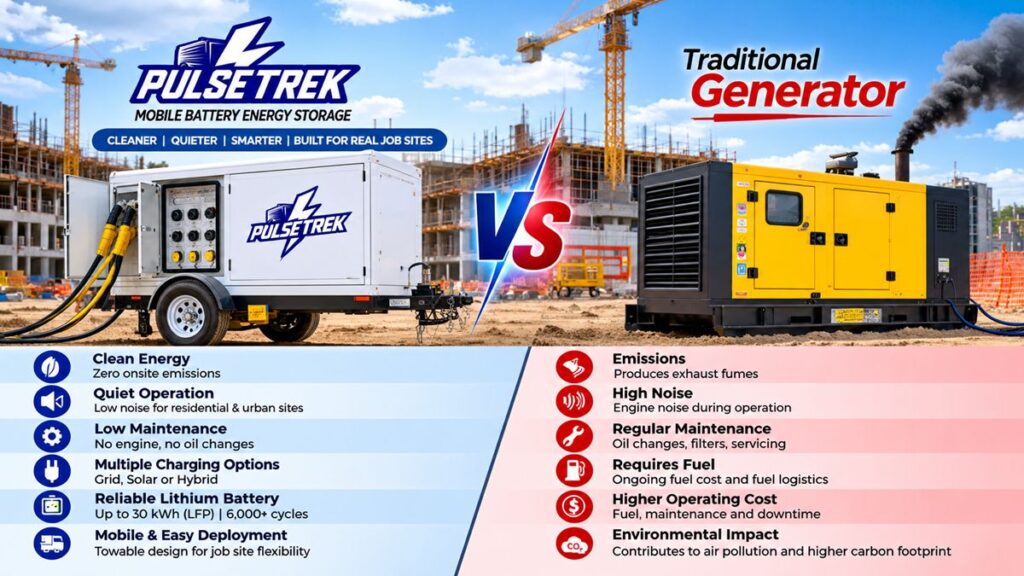
| Feature | Portable Battery Power Station | Fuel-Powered Generator |
|---|---|---|
| Energy Source | Stored electrical energy | Gasoline, diesel, or other fuel |
| Operating Noise | Typically much quieter | Engine noise during operation |
| On-Site Exhaust | No combustion exhaust during discharge | Produces exhaust |
| Refueling | Requires recharging | Requires fuel |
| Engine Maintenance | No combustion engine | Regular engine maintenance |
| Runtime | Depends on battery capacity and load | Depends on fuel supply and load |
| Solar Integration | Available on compatible systems | Requires additional equipment |
| Mobility | Depends on battery size and design | Depends on generator size and design |
| Best Applications | Quiet, temporary, and rechargeable power | Long-duration or high-load operations with fuel access |
Neither technology is universally better. The right choice depends on power requirements, operating environment, and available charging infrastructure.
1. Noise Reduction at Construction Sites
Noise is an important consideration for residential construction, commercial renovation, urban development, and nighttime maintenance.
Traditional generators produce engine noise while operating. Depending on the equipment and location, this may create challenges near homes, offices, schools, or other occupied buildings.
Battery-powered systems eliminate continuous combustion-engine noise during discharge, although cooling fans and connected equipment may still produce sound.
This makes mobile battery energy storage particularly useful for:
- Residential construction projects
- Indoor and outdoor renovation work
- Urban construction sites
- Temporary site offices
- Film production and outdoor events
- Noise-sensitive maintenance operations
For contractors working in populated areas, quieter power equipment can improve the working environment.
2. Fuel Costs and Operating Expenses
Fuel expenses are a major consideration when choosing temporary power equipment.
A traditional generator requires ongoing fuel purchases, and fuel consumption depends on its size, efficiency, and operating load.
Generators may also require oil changes, filters, inspections, and mechanical servicing.
A battery-powered power station requires electricity for charging rather than fuel for continuous on-site combustion.
Potential operating benefits include:
- Reduced on-site fuel handling
- Less engine-related maintenance
- Fewer fuel deliveries
- Greater flexibility in charging schedules
- Reduced generator runtime in hybrid systems
However, batteries still have costs, including electricity, charging infrastructure, capital investment, and eventual component replacement.
For an accurate comparison, contractors should calculate total cost of ownership rather than focusing only on the purchase price.
3. Portable Power Station Runtime: How Long Will It Last?
One of the most common questions about battery-powered generators is how long they can operate before needing a recharge.
Battery runtime depends primarily on two factors:
Battery capacity (kWh) and equipment power consumption (kW).
A simplified calculation is:
Runtime (hours) = Usable Battery Energy (kWh) ÷ Average Load (kW)
For example, a hypothetical battery system with 24 kWh of usable energy supplying a steady 3 kW load would provide approximately eight hours of operation.
Actual runtime can vary because of inverter losses, battery reserve settings, temperature, and changing electrical loads.
This is why contractors should measure the actual power consumption of their tools and equipment before selecting a system.
Why Peak Power Matters
Battery capacity alone does not determine whether a power station can operate a particular machine.
Electric motors, compressors, pumps, and other equipment may require substantially more power during startup than during normal operation.
Contractors should therefore evaluate:
- Continuous inverter output
- Peak or surge power
- Battery capacity
- Outlet voltage and configuration
- Equipment startup requirements
- Recharging time
A properly sized mobile power system must support both energy consumption and peak electrical demand.
4. Can a Portable Power Station Run Construction Tools?
Yes, provided the system has sufficient electrical capacity and compatible outputs.
Depending on its specifications, a commercial battery power station may support:
- Cordless tool battery chargers
- LED construction lighting
- Laptops and site-office equipment
- Security cameras
- Communication systems
- Selected saws and drills
- Pumps and other compatible equipment
High-demand machinery requires additional planning.
For example, operating several power tools simultaneously may exceed the continuous output rating of a smaller battery station.
Large commercial systems are designed to address more demanding applications, but equipment compatibility should always be verified before deployment.
5. Solar Generator vs Portable Power Station
The term solar generator is often used to describe a battery power station that can recharge using solar panels.
Unlike a conventional fuel generator, the battery does not create electricity by itself. It stores electricity supplied by the grid, solar panels, or another compatible charging source.
Solar-compatible battery storage offers additional flexibility for remote applications.
Potential benefits include:
- Renewable energy integration
- Reduced dependence on fuel deliveries
- Supplemental daytime charging
- Support for off-grid applications
- Flexible hybrid power configurations
Solar charging performance depends on panel capacity, weather conditions, available sunlight, and electrical demand.
For professional job sites, solar power is often most useful when combined with battery storage and a carefully planned charging strategy.
6. Introducing PulseTrek: Mobile Battery Power for Construction Sites
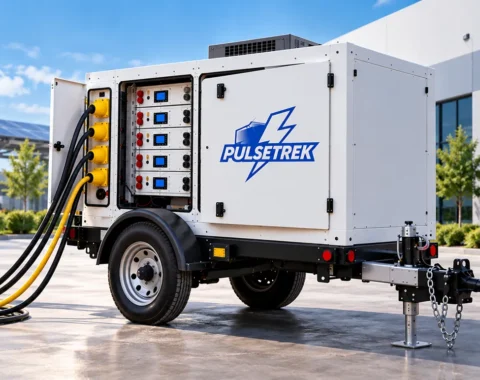
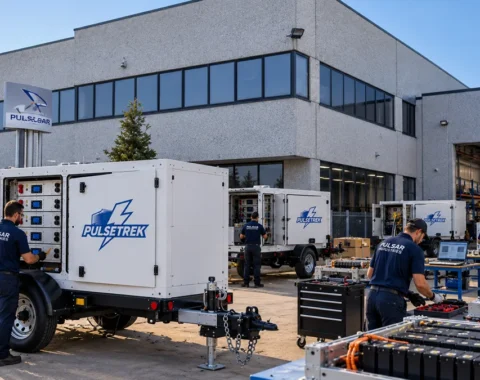
For contractors who need more than a small consumer portable power station, PulseTrek by Pulsar Industries provides a trailer-mounted mobile lithium battery system designed for professional applications.
PulseTrek combines lithium iron phosphate battery technology, power electronics, and a towable platform to deliver stored electricity directly to the job site.
Instead of relying entirely on an engine-driven generator, contractors can charge the battery system and transport it to locations where temporary electricity is needed.
Key PulseTrek Features
Mobile Battery Energy Storage
PulseTrek is available in configurations with up to 30 kWh of LFP battery storage.
Lithium Iron Phosphate Technology
Its LFP battery system is specified for more than 6,000 cycles under the manufacturer’s stated conditions.
Quiet Operation
The system supplies battery power without continuous engine combustion.
Outdoor-Oriented Construction
A NEMA 3R enclosure is designed for suitable outdoor electrical applications.
EV Charging Capabilities
Selected PulseTrek models support electric vehicle charging, including Level 1 and Level 2 options.
Solar Expansion
Optional solar integration provides another potential charging source.
Mobile Deployment
The towable trailer design allows the system to be transported between appropriate work locations.
These features position PulseTrek as a commercial mobile energy storage solution rather than a small household power bank.
Learn more: https://pulsar.industries/pulsetrek-lithium-battery-backup-system/
7. Where Can Mobile Battery Power Be Used?
Residential Construction
Mobile battery systems can support lighting, tool charging, and selected equipment in neighborhoods where generator noise may be undesirable.
Commercial Renovation
Battery-powered temporary electricity can be useful for projects requiring cleaner and quieter operation near occupied spaces.
Remote Job Sites
Towable energy storage allows contractors to transport stored electricity to locations without convenient grid connections.
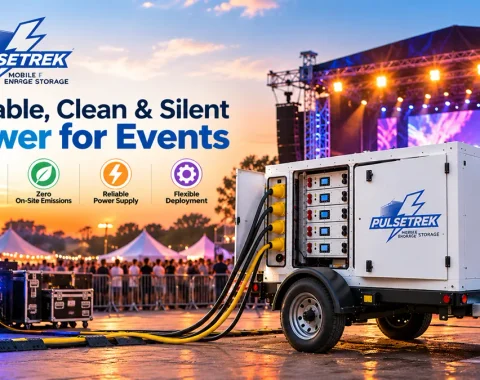
Outdoor Events and Film Production
Temporary production environments often require flexible electrical power for lighting, communication equipment, and supporting infrastructure.
Emergency Response
Mobile battery storage can support selected communication, lighting, and emergency equipment when conventional electricity is unavailable.
Electric Vehicle Fleet Support
Compatible mobile energy storage systems can provide charging support for electric vehicles operating away from permanent charging infrastructure.
8. Portable Power Station vs Generator: Which Is More Cost-Effective?
The most cost-effective option depends on the application.
A conventional generator may have a lower initial purchase cost and may be preferable when substantial continuous power is required and fuel is readily available.
A battery power station may offer advantages when equipment operates intermittently, quiet operation is valuable, and affordable charging electricity is available.
Contractors should compare the following costs over the expected equipment lifespan:
- Equipment purchase or rental
- Fuel or electricity
- Maintenance and servicing
- Transportation and logistics
- Charging infrastructure
- Battery replacement or equipment depreciation
- Downtime and operational requirements
A realistic financial comparison should use the project’s actual operating hours, electrical loads, and energy costs.
9. How to Choose the Right Portable Power Solution
Before purchasing or renting a portable battery power system, ask these questions:
What equipment needs electricity?
Create a list of tools, lighting systems, office equipment, and other electrical loads.
How much power is required?
Calculate continuous and peak demand.
How many hours must the system operate?
Estimate daily energy consumption in kilowatt-hours.
Where will charging take place?
Determine whether grid electricity, solar panels, or a hybrid charging source will be available.
How frequently will the system move?
Choose a transportable system that suits the project’s mobility requirements.
What operating conditions are expected?
Consider temperature, rain exposure, dust, electrical safety, and installation requirements.
What is the total operating budget?
Compare the full lifecycle cost of battery storage and conventional generators.
Answering these questions will help identify whether a compact portable station, commercial mobile battery trailer, or conventional generator is most appropriate.
10. The Future of Battery-Powered Construction Equipment
Construction companies are increasingly evaluating ways to reduce operating noise, improve energy flexibility, and support electrified equipment.
Mobile battery energy storage can play an important role in this transition.
Rather than depending on one fixed source of electricity, contractors can combine grid charging, battery storage, solar generation, and conventional backup equipment when appropriate.
This approach can help construction teams match their energy systems to the needs of individual projects.
Products such as PulseTrek demonstrate how transportable battery technology can support professional operations that traditionally relied on portable generators.
Frequently Asked Questions
A portable power station stores electricity in rechargeable batteries, while a conventional generator produces electricity by burning fuel. Battery systems are generally quieter during operation and do not produce combustion exhaust while discharging.
It can replace a diesel generator for certain applications when battery capacity, inverter output, runtime, and charging availability meet the project’s requirements. Some high-demand operations may still require generators or hybrid systems.
Runtime depends on usable battery capacity and electrical load. Larger loads reduce runtime, while smaller or intermittent loads generally allow longer operation.
Yes. Commercial-grade systems can support compatible tools, lighting, communications, and temporary site equipment. System sizing is essential.
Some commercial mobile battery systems include EV charging capabilities. PulseTrek offers EV charging options on selected models, including Level 1 and Level 2 configurations.