When severe weather, natural disasters, grid failures or other emergencies interrupt electricity, restoring access to power quickly becomes a critical priority.
Communication equipment needs electricity. Temporary response centers need lighting. Medical and refrigeration equipment may require backup power. Pumps, security equipment, charging stations and other essential systems may also need to continue operating while normal electrical infrastructure is unavailable.
Traditionally, portable generators have played a major role in emergency power.
But battery technology is creating another option: mobile battery energy storage.
Instead of relying entirely on continuously running fuel-powered equipment, organizations can transport stored electrical energy directly to locations where temporary power is needed.
For emergency teams, utilities, businesses and infrastructure operators, that creates a more flexible approach to disaster-response power.
Why Mobile Power Matters During an Emergency
A permanent backup system is useful when the equipment that needs electricity remains in one location.
Disasters are different.
Power may be required at several locations, and those locations can change as recovery operations progress.
A mobile energy storage system can be transported to a response area and repositioned as priorities change.
For example:
Storage Facility → Emergency Site → Temporary Shelter → Critical Facility → Recovery Site
Instead of electricity being tied to one permanent installation, the stored energy can move closer to the equipment that needs it.
That mobility is one of the most important advantages of trailer-based battery storage.
Pulsar Industries lists emergency response and disaster recovery among the applications served by its energy-storage solutions.
What Can Mobile Battery Storage Power During Disaster Recovery?
Every emergency has different electrical requirements, so the equipment and battery capacity must be evaluated for the specific application.
Potential loads can include:
- Emergency lighting
- Communication equipment
- Temporary command centers
- Medical equipment
- Refrigeration
- Security systems
- Computers and networking equipment
- Battery and device chargers
- Pumps and monitoring equipment
- Temporary shelters
- Field equipment
- EV charging
The important question is not simply, “How large is the battery?”
Operators need to understand how much power equipment requires, how long it must operate and whether any equipment has high startup or peak-power requirements.
Rapid Deployment Can Be as Important as Battery Capacity
During normal operations, businesses can plan electrical infrastructure months in advance.
Emergency response does not offer that luxury.
A temporary power solution needs to reach the required location quickly.
Trailer-mounted battery systems can help because the battery, power electronics and supporting equipment are integrated into a transportable platform.
The system can be stored in a ready location and transported when required rather than constructing temporary electrical infrastructure from scratch at every deployment site.
This is where products such as PulseTrek become particularly relevant.
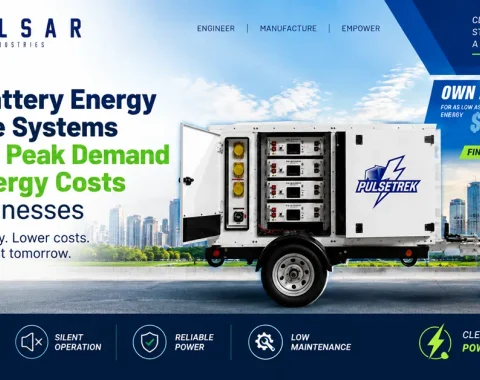
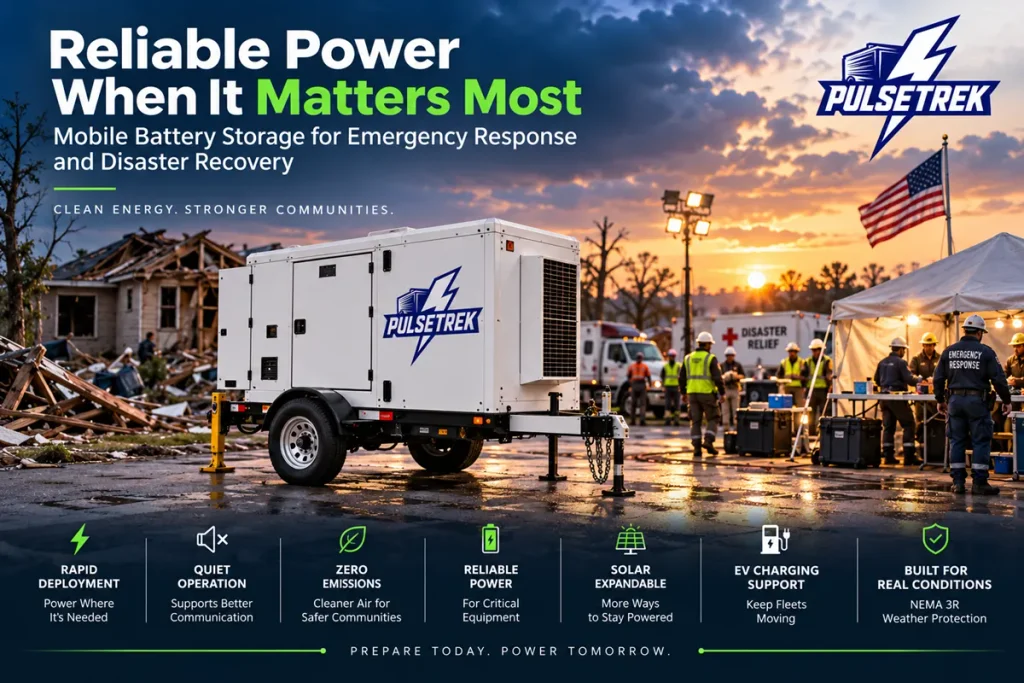
PulseTrek is a mobile lithium battery system mounted on a towable trailer, allowing stored electrical energy to be transported between locations.
Quiet Power Can Matter During Emergency Operations
Noise may seem like a minor issue during a power outage, but emergency environments depend heavily on communication.
Teams may need to coordinate operations, speak over radios, communicate with residents or work around temporary shelters and occupied facilities.
A continuously operating combustion engine introduces background noise into that environment.
Battery energy storage supplies stored electricity without requiring an engine to run continuously.
For temporary command centers, nighttime operations, shelters and communication areas, quieter power can make the working environment easier to manage.
PulseTrek is specifically positioned by Pulsar Industries around silent battery operation.
No Tailpipe Exhaust During Battery Operation
Battery storage also differs from conventional generators because the battery does not burn fuel while supplying stored electricity.
As a result, there is no tailpipe exhaust during battery operation.
This can be valuable around populated response areas and locations where combustion exhaust would create additional operating constraints.
The distinction is important: the environmental impact of the electricity still depends on how that electricity was originally generated and how the battery was charged.
But at the point where the battery is supplying stored energy, there is no combustion engine producing local exhaust.
Reducing Dependence on Fuel Logistics
Fuel availability can become more complicated during a major disruption.
Road closures, supply interruptions and increased regional demand can affect normal fuel logistics.
Traditional generators may require:
Fuel purchasing → Transportation → On-site storage → Refueling → Continued delivery
Battery storage creates another energy pathway.
A battery can be charged when electricity is available and then transported to the location where that stored electricity is needed.
Depending on the infrastructure and system configuration, batteries can also work with other energy sources rather than functioning as an isolated system.
Solar + Battery Can Extend Emergency Energy Options
One particularly useful combination for longer recovery operations is:
Solar → Battery Storage → Critical Loads
Solar generation can contribute electricity during available sunlight, while battery storage allows some of that energy to be retained for later use.
This can be particularly valuable where normal grid infrastructure remains unavailable for an extended period.
It does not mean solar and batteries can automatically support every emergency load indefinitely.
Available solar generation, weather conditions, battery capacity, charging rates and electrical demand all affect system performance.
But adding solar can give response teams another potential source of electricity.
PulseTrek is currently described by Pulsar Industries as solar-expandable.
Battery + Generator Can Also Work Together
Emergency power does not have to be a choice between a battery or a generator.
For some applications, the better approach may be:
Battery + Generator + Solar
Each technology can serve a different purpose.
The battery can provide quiet stored electricity and handle suitable loads. Solar can contribute energy when conditions permit. A generator can provide additional energy when loads or required runtime exceed available battery capacity.
This type of hybrid approach can provide greater flexibility than expecting one technology to handle every emergency scenario.
Why LFP Batteries Are Relevant for Mobile Energy Storage
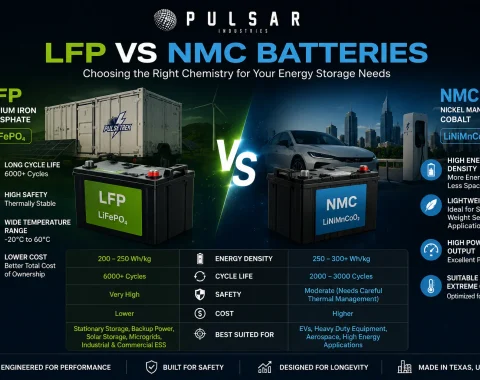
PulseTrek uses Lithium Iron Phosphate (LFP) battery technology. Pulsar Industries currently lists PulseTrek configurations with up to 30 kWh of LFP energy storage and 6,000+ cycles.
For mobile and repeated-use applications, battery chemistry affects factors such as cycle life, system design, operating conditions and overall lifecycle.
A disaster-response system may spend significant periods waiting for deployment and then suddenly be required to perform when infrastructure fails.
That makes appropriate battery management, inspection, charging and maintenance procedures particularly important.
Weather Protection for Field Deployment
Emergency power equipment may need to operate outdoors rather than inside a controlled electrical room.
Rain, dust, temperature and general field conditions therefore need to be considered.
PulseTrek uses a NEMA 3R weatherproof enclosure, according to current Pulsar Industries product information.
The enclosure does not eliminate the need for correct deployment procedures, but outdoor-oriented construction is important for equipment intended to move between real-world operating environments.
Mobile EV Charging During Recovery Operations
Electrification is also changing emergency transportation.
As fleets incorporate electric vehicles, restoring electricity after a disaster may increasingly involve restoring access to charging as well.
Fixed EV chargers depend on available electrical infrastructure.
If that infrastructure is damaged or temporarily unavailable, mobile battery storage can potentially bring stored electricity closer to vehicles that need charging.
PulseTrek’s current configurations include EV-charging capabilities, including Level 1 support on the Base Model+ and a 32-amp Level 2 charger on the Performance Model.
That creates another potential role for mobile energy storage beyond simply powering conventional electrical equipment.
How to Size an Emergency Battery System
There is no single battery capacity that is right for every emergency.
Before selecting a system, operators should identify their critical loads first.
A practical assessment should consider:
1. Continuous Power Demand
How much power is required during normal operation?
2. Peak Power Demand
Do pumps, motors, compressors or other equipment require higher startup power?
3. Required Runtime
Does the system need to operate for two hours, eight hours or overnight?
4. Recharge Strategy
Will grid electricity, solar, another generator or a combination be available?
5. Mobility
How frequently will the system need to move?
6. Deployment Environment
Will it operate outdoors or under challenging environmental conditions?
7. Critical vs Non-Critical Loads
Which equipment absolutely must remain powered?
This load-first approach prevents organizations from choosing a battery solely because its kWh number looks large.
Mobile Energy Storage Adds Another Layer of Resilience
Emergency preparedness is ultimately about having options.
The grid may be available.
Sometimes it will not be.
Solar may be producing electricity.
Sometimes weather will limit production.
A generator may be available.
Sometimes fuel logistics become difficult.
Mobile battery energy storage adds another layer to that strategy by allowing electricity to be stored before it is needed and transported to where it is needed.
That is a fundamentally different capability from relying only on real-time electricity generation.
PulseTrek: Mobile Energy for When Power Cannot Wait
Pulsar Industries designs and manufactures battery systems in Texas, with capabilities spanning battery engineering, energy storage and in-house manufacturing. Its current product portfolio includes PulseTrek mobile power trailers alongside other battery and energy-storage technologies.
For emergency response and disaster recovery, PulseTrek provides a transportable battery platform designed to bring stored electricity closer to the point of need.
When conventional infrastructure is unavailable, the ability to store, move and deploy power can become an important part of a resilient emergency-energy strategy.