How to Engineer a Battery Energy Storage System for Reliable Industrial Power
Industrial operations depend on reliable electricity. Manufacturing equipment, automation systems, warehouses, charging infrastructure, communications, refrigeration and critical facility systems can all be affected when power becomes unstable or unavailable.
As businesses electrify more equipment and integrate renewable energy, many are looking beyond conventional backup solutions toward Battery Energy Storage Systems (BESS).
But an effective industrial BESS is much more than a large battery.
A reliable energy storage system requires battery cells, mechanical design, thermal management, a Battery Management System (BMS), power conversion equipment, controls, electrical protection and software to operate together as one integrated system.
That is why successful energy storage projects begin with engineering—not simply choosing the largest available kWh rating.

Start With the Real Power Requirement
Every BESS project should begin with the application.
A manufacturing facility has different requirements from a construction site, logistics center, EV charging depot or renewable-energy installation.
Before selecting battery capacity, engineers need to understand how electricity is actually being used.
Important considerations include continuous power demand, peak loads, required backup duration, available charging time, voltage, environmental conditions and future expansion.
For example, a facility may consume significant energy throughout the day but only need to maintain a smaller group of critical loads during a grid interruption.
Correctly identifying those loads can help determine a more appropriate battery configuration.
Pulsar Industries emphasizes application and load analysis as part of its energy-storage engineering approach rather than forcing every project into a standard configuration.
Battery Chemistry Should Match the Application
Battery chemistry affects performance, lifecycle, thermal behavior, weight, packaging and system design.
For many stationary and semi-mobile energy-storage applications, Lithium Iron Phosphate (LFP) can offer characteristics such as long cycle life and strong thermal stability.
However, chemistry should not be selected based on popularity alone.
The appropriate choice depends on how frequently the battery will cycle, operating temperature, physical constraints, required power and expected service life.
Pulsar Industries describes its approach as technology-agnostic, selecting chemistry, battery format and BMS architecture according to the application’s actual performance requirements.
The BMS Is the Intelligence Behind the Battery
The battery cells store energy, but the Battery Management System plays an essential role in monitoring and controlling the pack.
Depending on the architecture, a BMS can monitor:
- Cell and pack voltage
- Current
- Temperature
- State of Charge
- State of Health
- Charging and discharging conditions
It can also help protect the battery from abnormal operating conditions.
In larger industrial systems, the BMS may communicate with inverters, Energy Management Systems and other facility controls.
This communication is particularly important when a BESS must respond automatically to changing loads, charging conditions or facility requirements.
Thermal Management Cannot Be an Afterthought
Battery performance and temperature are closely connected.
Industrial systems may operate outdoors, inside equipment rooms, in hot environments or under demanding charge and discharge cycles.
That makes thermal management an important engineering consideration.
The system needs to maintain battery components within appropriate operating conditions while accounting for enclosure design, airflow, cooling strategy and environmental exposure.
Poor thermal design can negatively affect performance and battery life.
For this reason, thermal management should be developed alongside the electrical and mechanical architecture rather than added after the battery pack has already been designed.
Power Electronics Connect Storage to the Application
Stored DC energy is only useful when it can be delivered in the form required by the application.
A Power Conversion System (PCS) or inverter provides the interface between the battery and AC electrical equipment.
Its design must consider continuous power, peak power, voltage requirements, charging strategy and integration with other energy sources.
In a solar-plus-storage application, for example, the system may need to coordinate solar generation, battery charging, facility demand and utility-grid interaction.
For EV charging infrastructure, the battery may need to deliver additional power during periods when several vehicles charge simultaneously.
Correctly engineering this interface is critical to overall BESS performance.
Industrial BESS Can Support More Than Backup Power
One of the major advantages of battery storage is its flexibility.
The same properly configured system may potentially support several energy-management objectives.
Applications can include peak-demand management, load shifting, renewable-energy integration, backup power, microgrid operation and EV charging support.
For example, a facility may charge its battery during periods of lower electrical demand and discharge it when facility demand increases.
Another business may prioritize solar-energy storage.
A manufacturing operation may focus primarily on resilience and critical-load support.
The correct strategy depends on the facility’s load profile, utility structure and operational priorities.
Solar and Battery Storage Work Together
Solar production does not always occur at the same time as electricity demand.
A facility may generate significant solar electricity during the middle of the day but require more power later.
Battery storage provides a way to capture compatible excess generation and make that energy available at another time.
A simplified energy flow might look like:
Solar Generation → Facility Loads → Battery Charging
Later:
Battery Storage → Facility Loads
This can improve the flexibility of on-site renewable generation and give facility operators more control over when stored electricity is consumed.
BESS Can Support High-Power EV Charging
Commercial EV fleets can introduce significant new electrical loads.
When multiple vehicles charge simultaneously, the resulting power demand may exceed the capacity available at an existing site.
Battery storage can be integrated into charging infrastructure to help manage these demand periods.
Instead of relying exclusively on instantaneous grid capacity, a battery can accumulate energy over time and contribute additional power when charging demand increases.
Pulsar identifies fleet charging facilities, logistics centers, workplace charging, construction fleets and remote charging locations among potential BESS-supported charging applications.
Prototype and Test Before Scaling
A battery system that performs well in a design model still needs to work reliably in the real world.
Prototype development allows engineers to evaluate electrical performance, packaging, thermal behavior, communication, controls and serviceability before moving into larger production.
Testing can reveal issues that may not be obvious during the initial design phase.
Connector access may need improvement.
Cable routing may need modification.
Thermal behavior may differ under sustained loads.
Software communication may require additional tuning.
Finding these issues during prototype validation is far easier than discovering them after a system has entered production.
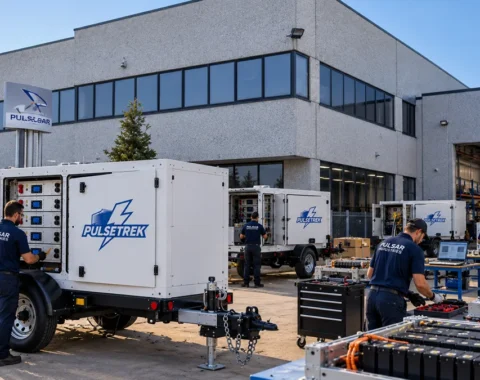
Pulsar Industries lists prototype fabrication and performance validation among its battery-system capabilities.
Design for Manufacturing From the Beginning
A prototype is only one part of a successful commercial battery program.
If the system will be manufactured repeatedly, engineers also need to consider assembly processes, component availability, quality control, service access and future engineering changes.
Pulsar Industries states that its Texas manufacturing operation supports low-volume custom builds through mid-volume production, including custom battery systems manufactured to customer specifications.
Designing for manufacturability early can reduce unnecessary complexity when a product moves from prototype to production.
Build the Complete System Around the Application
The most important lesson in industrial energy storage is simple:
A BESS should be engineered as a complete system.
Battery capacity matters, but so do power requirements, BMS architecture, thermal management, mechanical packaging, power conversion, controls, protection, monitoring and manufacturability.
Pulsar Industries brings these disciplines together through battery engineering, prototype development and manufacturing capabilities.
From portable power and commercial storage to construction applications, critical infrastructure and custom battery systems, the objective is to develop energy storage around the real operating environment rather than treating batteries as a one-size-fits-all commodity.
As industrial electricity requirements continue to evolve, businesses will need energy systems that are not only capable of storing power but also intelligently managing how that energy is delivered.
That is where properly engineered battery energy storage becomes valuable.