Electric vehicles are rapidly changing how businesses manage transportation, construction equipment, service fleets, and field operations. But as EV adoption grows, a practical challenge is becoming increasingly important: what happens when an electric vehicle needs power in a location without convenient charging infrastructure?
Permanent EV charging stations work well at homes, offices, depots, and established commercial locations. However, construction sites, temporary projects, remote work areas, outdoor operations, and changing fleet locations may not always have access to fixed charging equipment.
This is where mobile EV charging can provide a new level of flexibility.
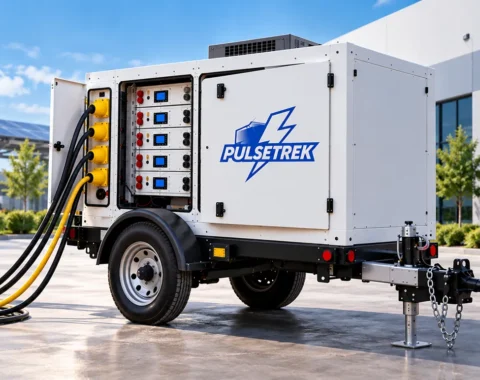
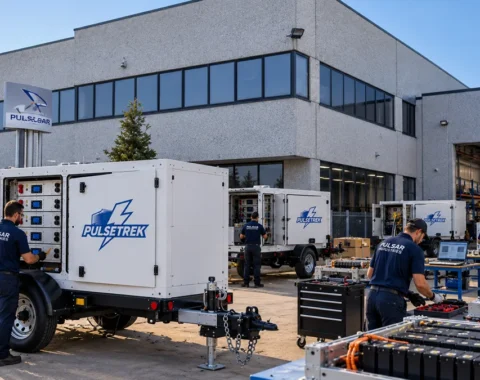
PulseTrek by Pulsar Industries combines mobile battery energy storage with a towable platform, making stored electrical energy easier to deploy where it is needed. For businesses operating beyond traditional charging infrastructure, this approach can help bridge the gap between electric mobility and temporary power availability.
What Is Mobile EV Charging?
Mobile EV charging refers to bringing electrical energy to a vehicle rather than requiring the vehicle to travel to a permanently installed charging station.
Think of it as taking the charging source to the point of need.
A mobile battery system can store electricity at one location, travel to another location, and provide power without requiring a permanent utility connection at every operating point.
This can be particularly useful for organizations whose vehicles or equipment regularly work at temporary or remote locations.
Instead of asking:
“Where is the nearest charging station?”
Businesses can begin asking:
“How can we bring stored energy closer to our vehicles?”
That shift can make electrification more practical for mobile operations.
Why Fixed Charging Infrastructure Is Not Always Enough
Traditional EV charging infrastructure is stationary.
That works well when vehicles repeatedly return to the same depot. But many commercial operations do not function that way.
A construction fleet may move from one project to another. Utility crews can spend days working away from their normal facility. Service vehicles may operate across large territories, while temporary sites can change as projects progress.
Installing permanent charging equipment at every temporary location may not make financial or operational sense.
Mobile battery energy storage offers another approach.
Stored energy can move with changing operational requirements, giving companies an additional option when permanent charging infrastructure is unavailable, impractical, or still under development.
PulseTrek: Energy That Can Travel With Operations
PulseTrek is a mobile LFP battery energy storage system built on a tow-behind trailer.
Rather than being permanently installed at one facility, it can be transported between locations depending on where electrical power is required.
This mobility creates an interesting opportunity for EV-support applications.
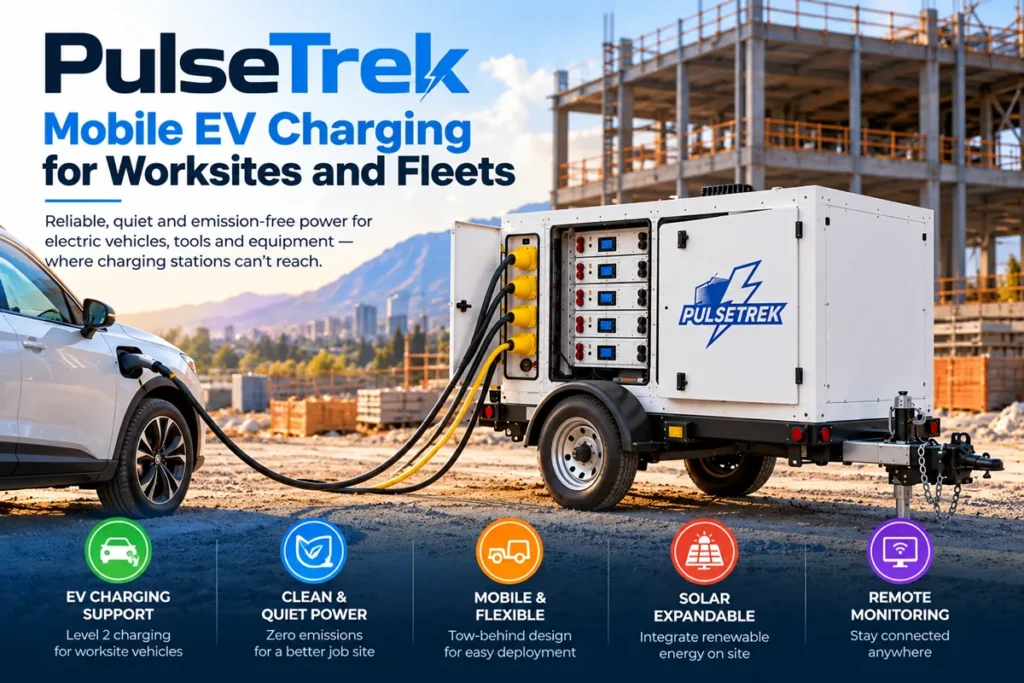
Selected PulseTrek configurations provide vehicle-charging capabilities, including a Performance Model designed with Level 2 EV charging support.
For businesses transitioning toward electric fleets, this means battery storage can become more than stationary backup power. It can become part of a flexible charging strategy.
Supporting EVs at Construction Sites
Construction is one industry where mobile charging can be particularly valuable.
Project sites are temporary by nature. Permanent electrical infrastructure may be incomplete during early phases of construction, while crews still need electricity for tools, equipment, offices, lighting, and increasingly electric vehicles.
As contractors introduce electric pickup trucks, utility vehicles, compact equipment, and other electrified assets, charging access becomes another part of project planning.
A mobile EV charging solution can help provide temporary access to stored electricity while the project evolves.
Once work is completed at one site, the mobile battery system can be relocated instead of leaving permanent charging infrastructure behind.
Mobile Charging for Commercial Fleets
Fleet electrification introduces a different challenge.
A company may have charging infrastructure at its main facility but still need additional charging flexibility during field operations.
Consider service technicians, maintenance teams, mobile contractors, utility crews, or businesses operating vehicles across several temporary locations.
A mobile energy storage platform can provide another layer of charging availability.
It does not necessarily replace permanent depot chargers. Instead, it can complement existing charging infrastructure by providing power where fixed chargers are difficult to access.
This can help businesses build a more flexible energy ecosystem around their electric fleet.
Helping Bridge Charging Infrastructure Gaps
EV infrastructure continues to expand, but charging availability is not uniform everywhere.
Urban areas may have multiple charging locations, while industrial sites, rural projects, new developments, and temporary workplaces may have fewer options.
Mobile battery storage can help bridge these infrastructure gaps.
Rather than waiting for permanent infrastructure to reach every operating location, organizations can deploy stored energy where demand currently exists.
This can be particularly valuable during the transition period when a company is adding electric vehicles faster than it can expand permanent charging infrastructure.
Emergency Charging Support
Another potential application is emergency or contingency charging.
Vehicles can sometimes arrive at a location with less remaining battery capacity than expected. Charging equipment can also become temporarily unavailable because of utility outages, maintenance, construction, or infrastructure problems.
Having access to transportable stored energy provides organizations with another contingency option.
For fleet managers, redundancy matters.
Just as businesses maintain backup systems for critical equipment, mobile energy storage can become part of a broader resilience strategy for electrified operations.
Combining Solar Energy With Mobile Charging
Mobile battery storage becomes even more interesting when renewable energy is incorporated into the system.
PulseTrek supports optional solar expansion.
During suitable operating conditions, solar generation can contribute energy to the battery system, which can later be used for supported electrical loads.
This creates opportunities for businesses looking to combine mobile battery storage, renewable energy, and EV charging within the same energy strategy.
The result is a flexible system that can potentially collect, store, transport, and deliver electrical energy according to operational requirements.
Why LFP Battery Technology Matters
PulseTrek uses Lithium Iron Phosphate, commonly known as LFP, battery chemistry.
For mobile energy storage applications, battery durability and cycle life are important because the system may be charged and discharged repeatedly throughout its operating life.
PulseTrek is designed around long-cycle-life LFP technology, making it suitable for applications where energy storage is expected to be used regularly rather than only during occasional emergencies.
This is particularly relevant for fleet applications, where charging demand can occur every working day.
Remote Monitoring Adds Operational Visibility
Managing mobile energy assets requires more than simply knowing where the trailer is located.
Operators also need visibility into system performance and available energy.
PulseTrek includes remote-monitoring capabilities, helping businesses keep track of the system while it is deployed.
For organizations operating multiple sites or managing distributed fleets, this visibility can help improve energy planning and equipment utilization.
Instead of treating portable power as an isolated piece of equipment, businesses can integrate it into a more connected energy-management strategy.
Mobile Charging Can Complement Permanent EV Stations
Mobile charging should not necessarily be viewed as a replacement for traditional EV charging stations.
The two can work together.
Permanent chargers are ideal for predictable, high-frequency charging at locations such as fleet depots, offices, parking facilities, and warehouses.
Mobile battery systems can address the situations permanent chargers cannot easily cover.
For example:
- Temporary construction locations
- Remote field operations
- New sites awaiting electrical infrastructure
- Emergency charging requirements
- Overflow charging during periods of high demand
- Mobile service and utility operations
- Special projects and temporary facilities
This combination can give organizations greater flexibility as their electric fleets grow.
A New Way to Think About EV Infrastructure
The future of EV charging may not depend exclusively on installing more stationary chargers.
It may also involve making energy itself more mobile.
As vehicles, equipment, and workplaces become increasingly electrified, businesses need energy solutions capable of adapting to changing operating environments.
A towable battery system such as PulseTrek represents a different approach: instead of requiring every vehicle to find a fixed source of electricity, stored energy can be transported closer to where demand exists.
That flexibility can become increasingly valuable for contractors, commercial fleets, utilities, industrial businesses, and organizations operating beyond traditional infrastructure.
Preparing for a More Electric Future
Fleet electrification is not simply about purchasing electric vehicles.
Organizations also need to consider where those vehicles will charge, how much energy will be required, what happens when operations move to temporary locations, and how charging availability can be maintained during unexpected situations.
Mobile battery energy storage can become one part of the answer.
With its transportable design, LFP battery system, remote monitoring, solar-expansion options, and available EV-charging capabilities, PulseTrek provides a flexible platform for businesses exploring mobile power and vehicle-charging applications.
As electric transportation continues to expand, bringing energy to the vehicle—not just bringing the vehicle to the charger—could become an increasingly important part of modern charging infrastructure.
Power Beyond the Charging Station
The transition to electric transportation requires infrastructure that can adapt to real-world operations.
PulseTrek gives businesses another way to think about that challenge.
Whether supporting temporary projects, commercial fleets, construction sites, remote operations, or contingency charging requirements, mobile battery storage can extend access to electricity beyond the boundaries of traditional fixed charging stations.
PulseTrek by Pulsar Industries brings stored energy closer to where work actually happens—helping businesses prepare for a more mobile, flexible, and electrified future.